
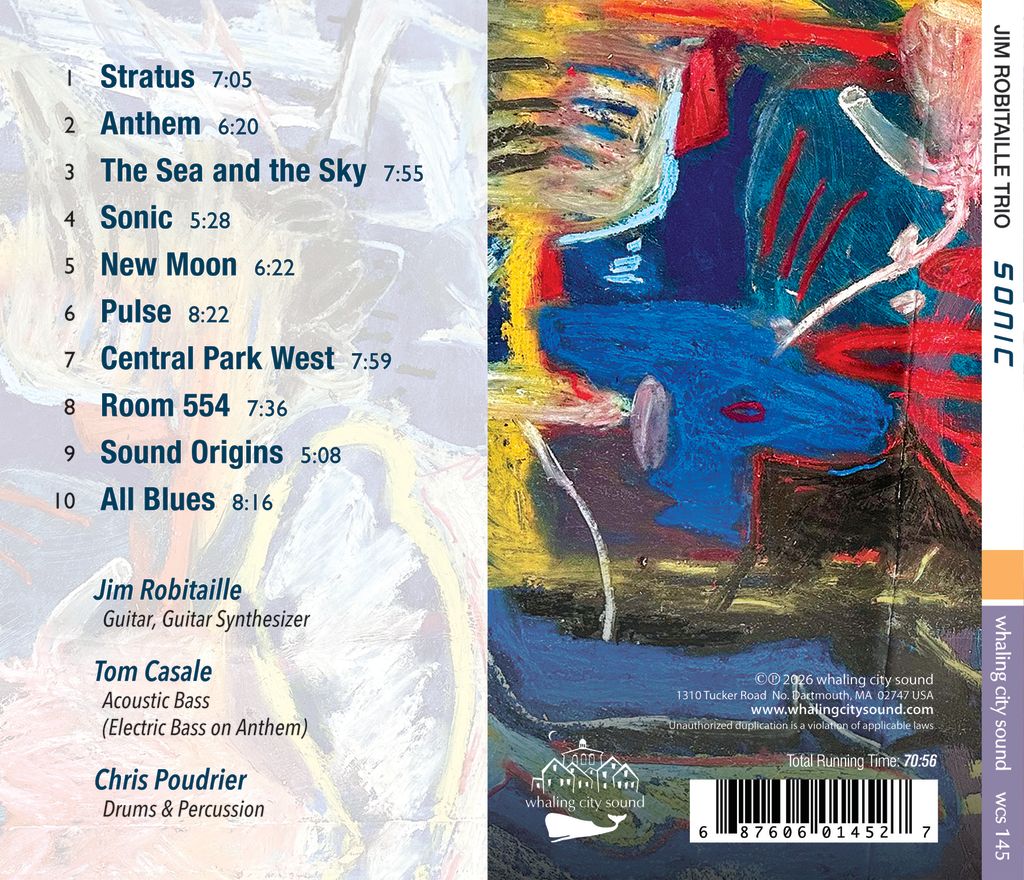
New Release “Sonic” Available now!
LABEL: Whaling City Sound
Jim Robitaille uses D’Addario Strings and Planet Wave products, and Chameleon speakers by Buscarino Guitars
Soundcloud “Sonic” featured track
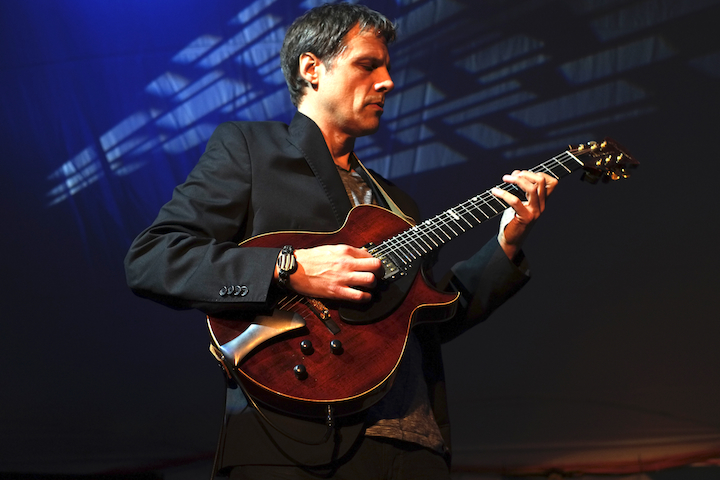
Photo: #1, #2
Publicity: All About Jazz, O’s Place Jazz Magazine, AllAboutJazz, Ocean State Media, JazzWax, National Law Review, The Wanderer, Wicked Local, Wareham Week, The Jazz Word, Jazz Journal, Jazz Weekly, The Patriot Ledger, Bill Copeland Music News, JazzQuad, South Coast Today, Jazz Journal, Cape News, UMASS, All About Jazz
Radio Promotion:
Biggest gainer, Most Added 5/11/20 JazzWeek
CDs: MVD shop
Books: Sound Origins: Developing Your Musical Identity
Mixed Media Client since: 2004


O’s Place Jazz Magazine review

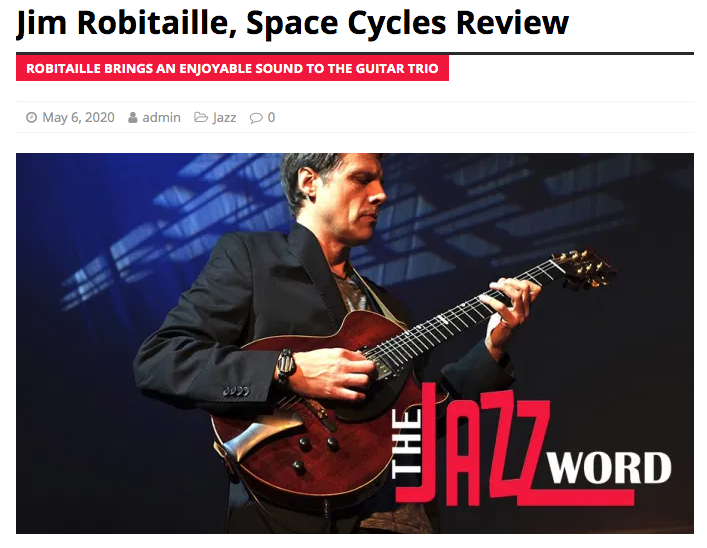
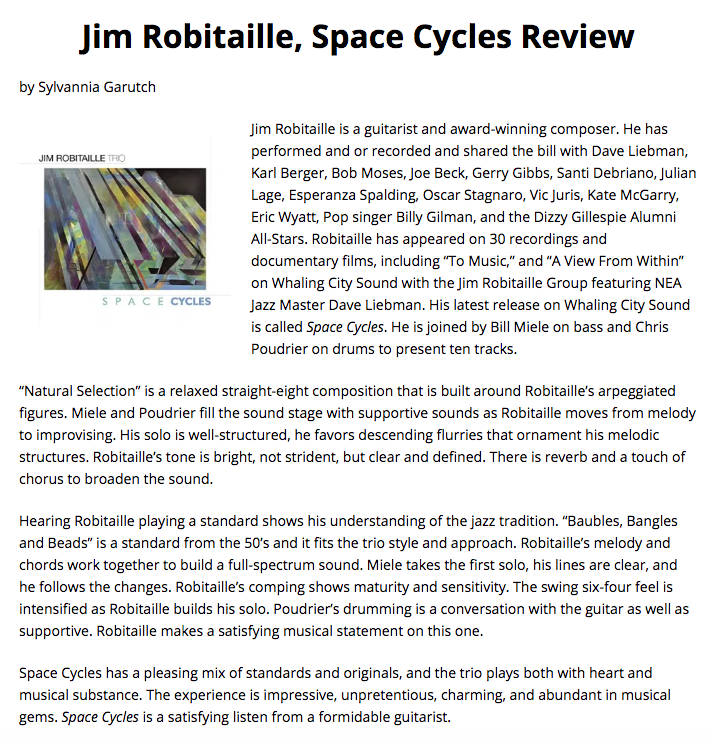
All About Jazz Sonic Review
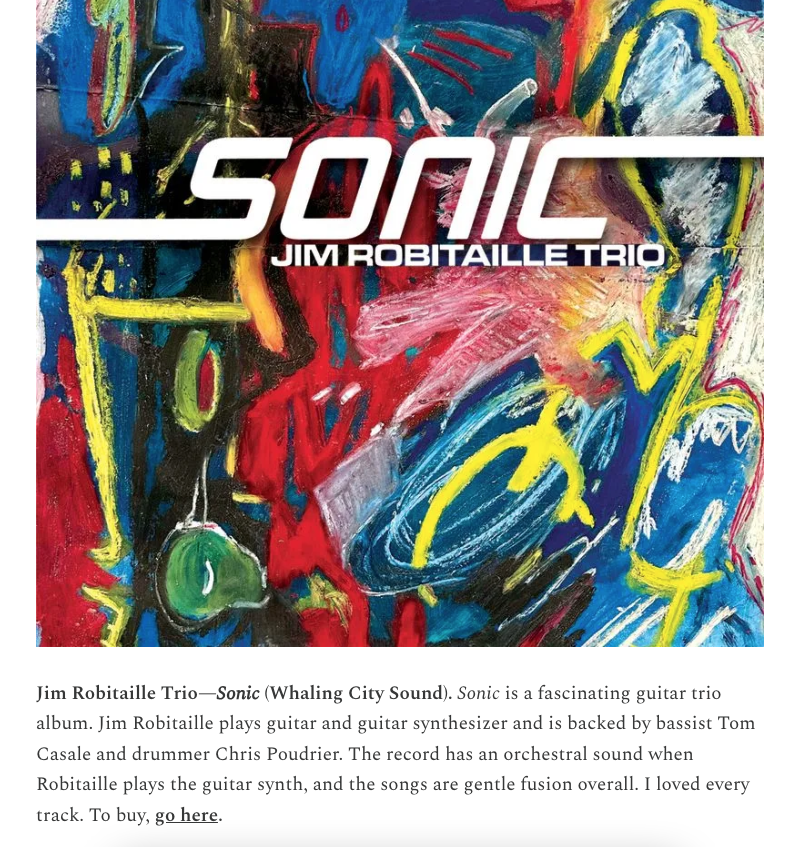
Click here to read the full review
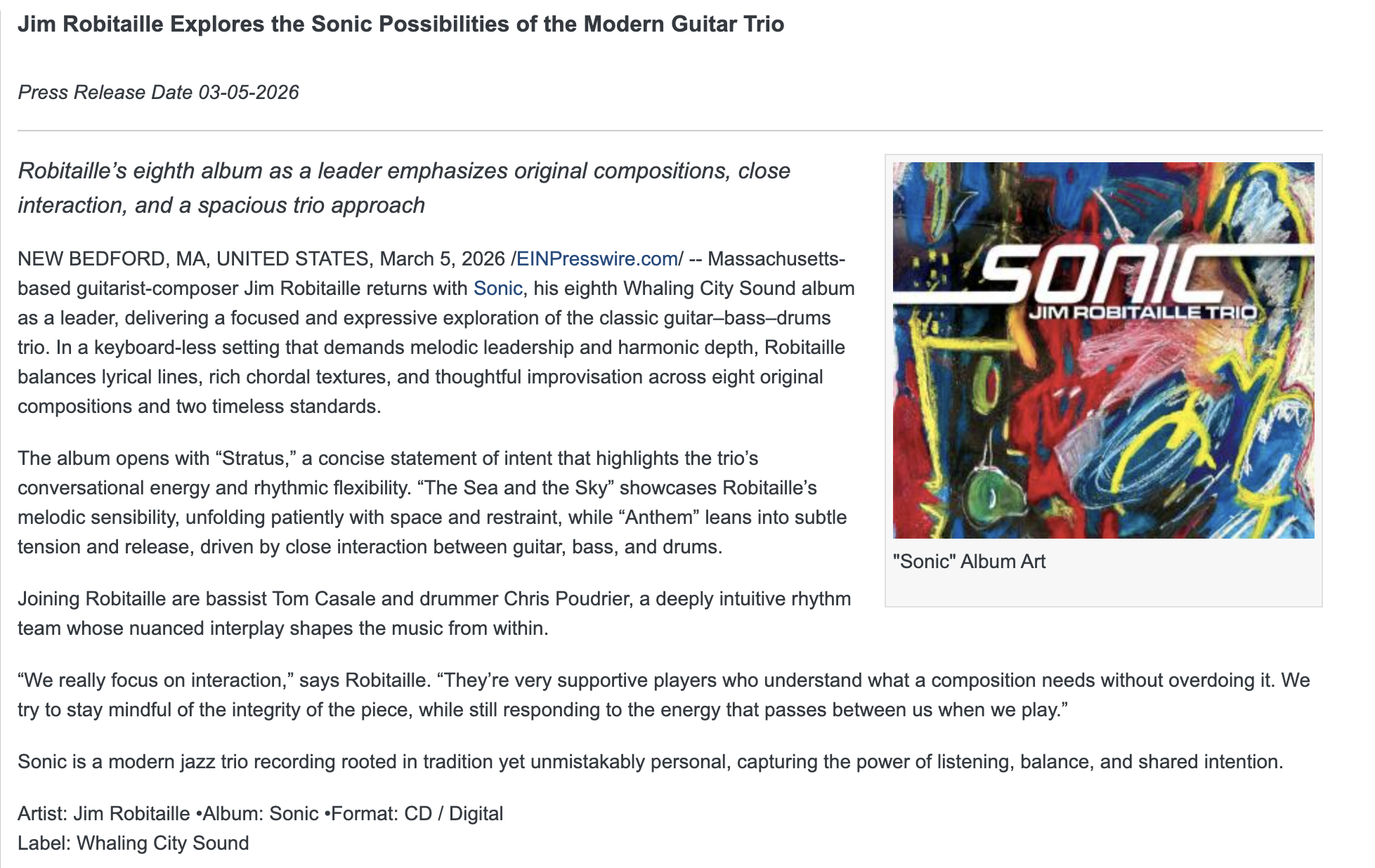
Jim Robitaille Explores the Sonic Possibilities of the Modern Guitar Trio – The National Law Review: https://natlawreview.com/press-releases/jim-robitaille-explores-sonic-possibilities-modern-guitar-trio

“Robitaille’s guitar tone articulates a palette of explosive creativity.
– Johnston Sunrise
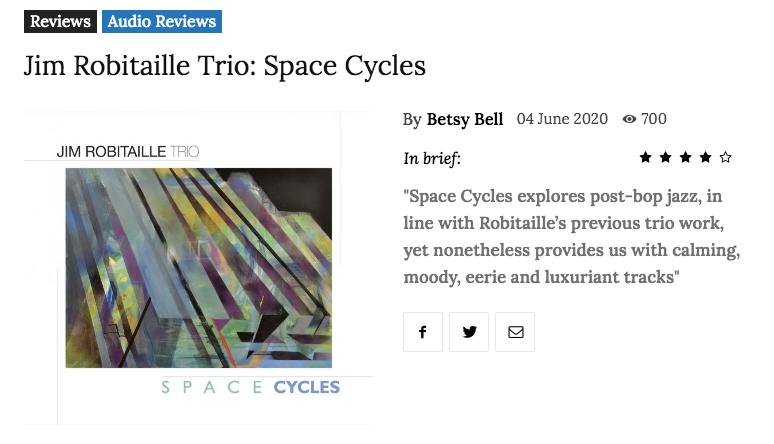
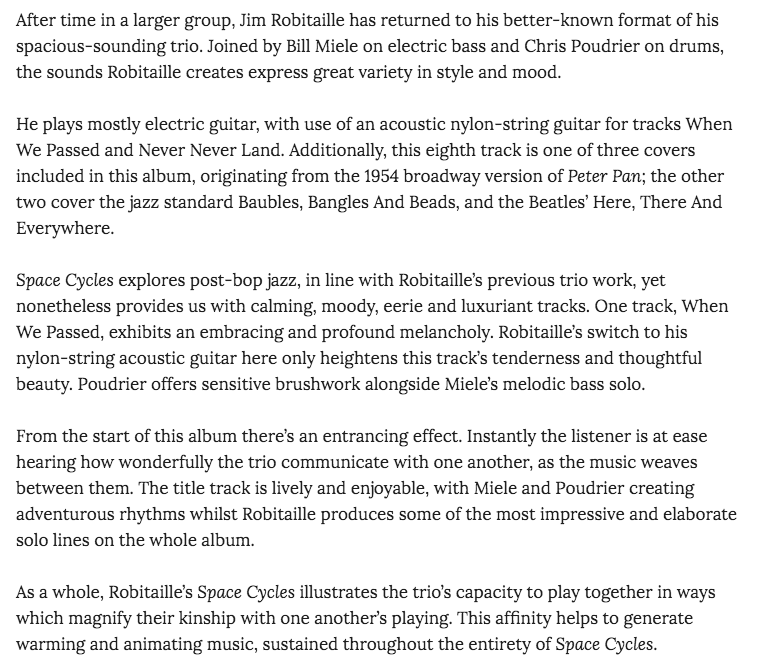
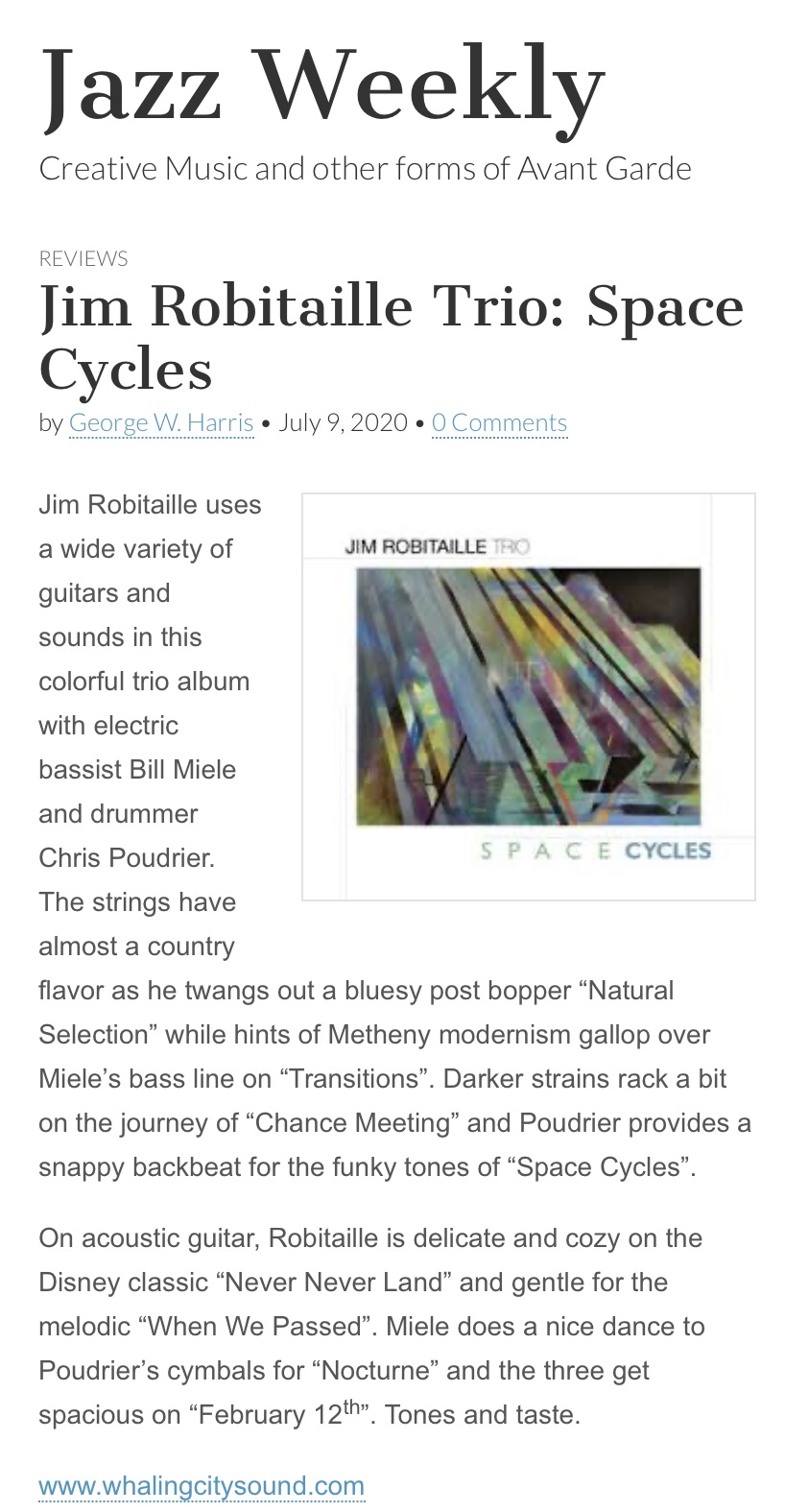
Space Cycles is a unique and extraordinary jazz album, that ventures beyond
conventional boundaries. – Midwest Review
Quite an impression is made on the listener as these players develop this piece into a breathtaking flight of fancy.– Bill Copeland
###

Click here to read the full article

Click here to read the full article

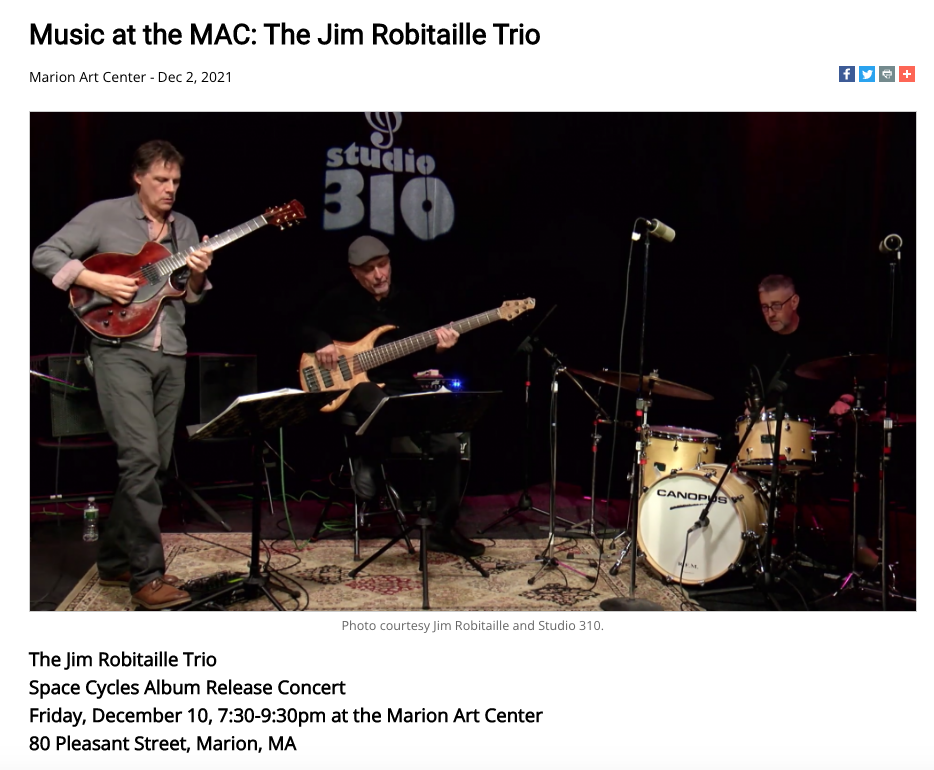
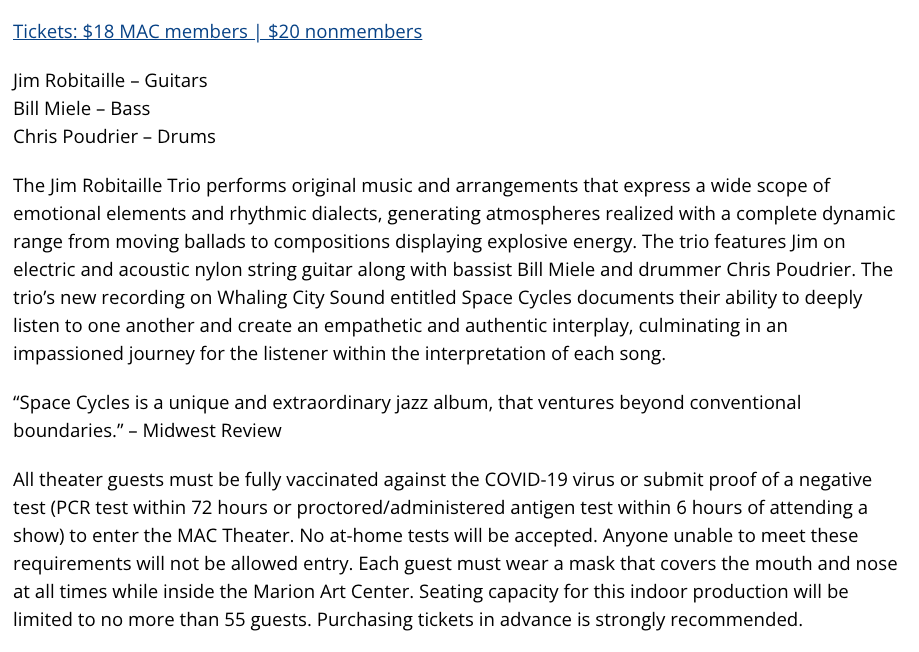
Click here to purchase tickets!
Click here to read the full article

JIM ROBITAILLE in concert THURSDAY, AUGUST 14, 2021, sets 5:30 + 7:15 PM
“Bossas, Ballads, and Blues” New Bedford AHA! Night (AHA is Art-History-Architecture)
A FREE arts & cultural event in Downtown New Bedford, MA

Fiber Optics Center and Whaling City Sound, 23 Center Street, New Bedford.

View this post on Instagram
Jim Robitaille Trio with Dino Govoni live at Gilda’s Stone Rooster
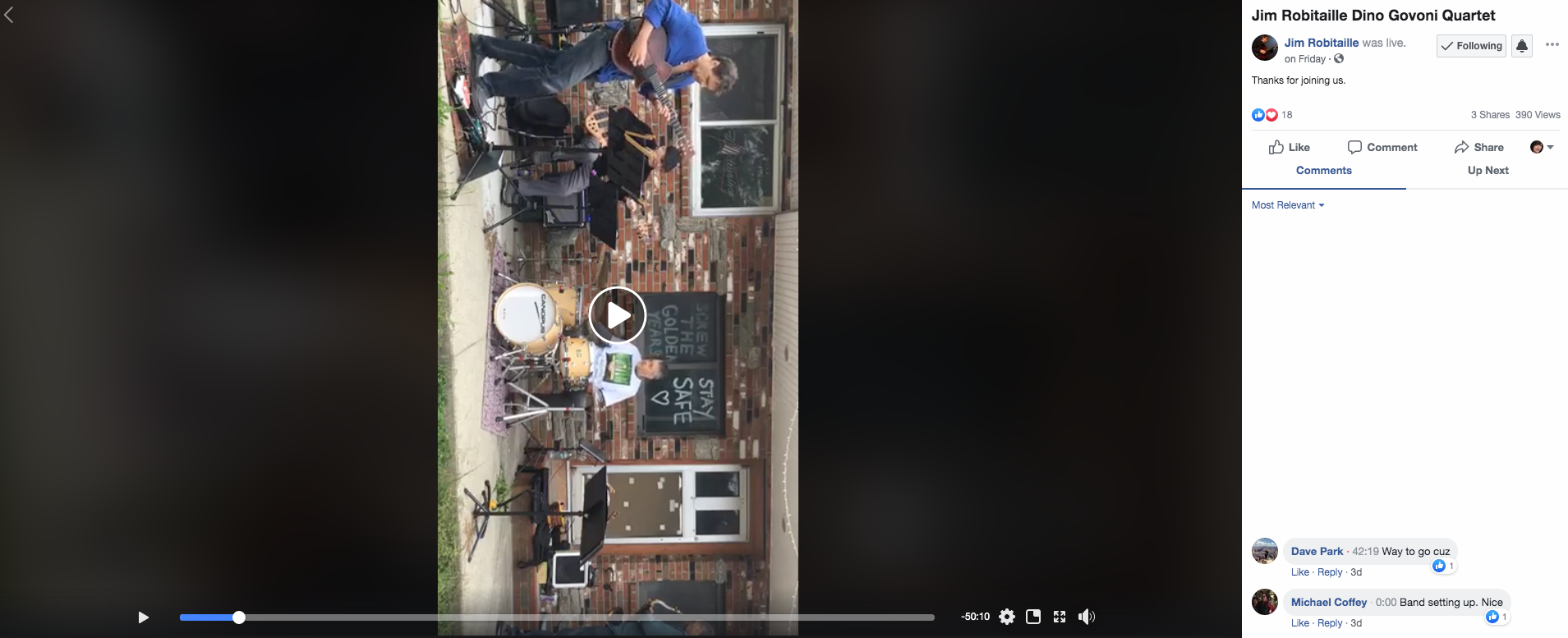
Click here to watch the performance!

Click here to read the full article!




Click here to read the full article!
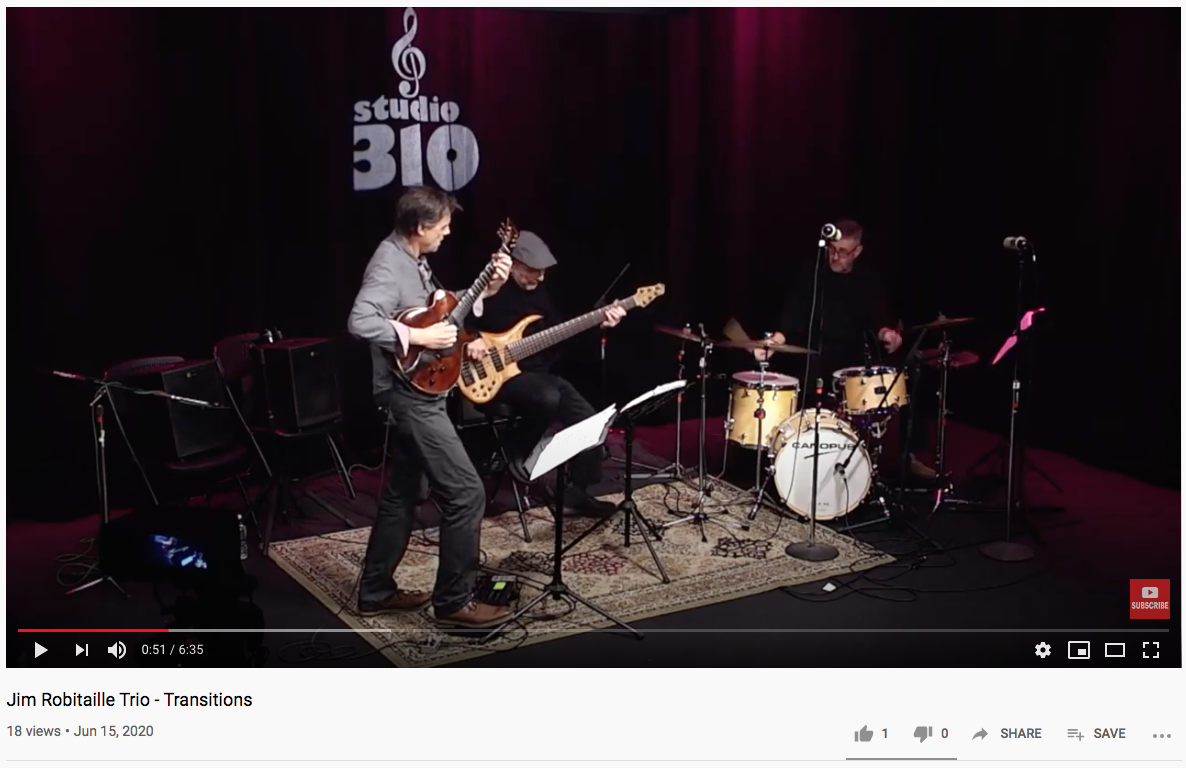
Click here to watch the full video!

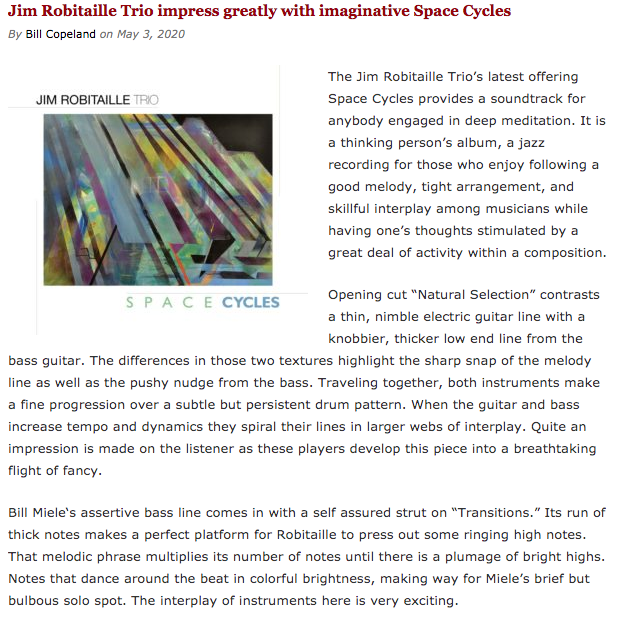
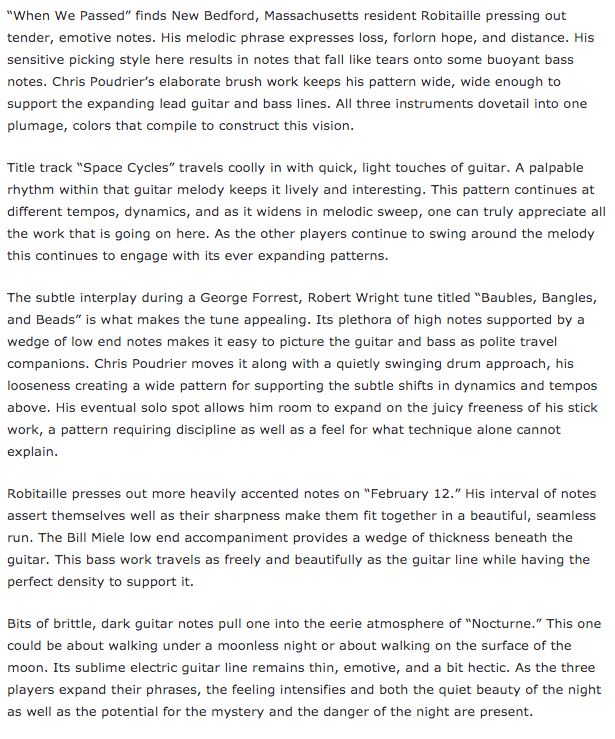
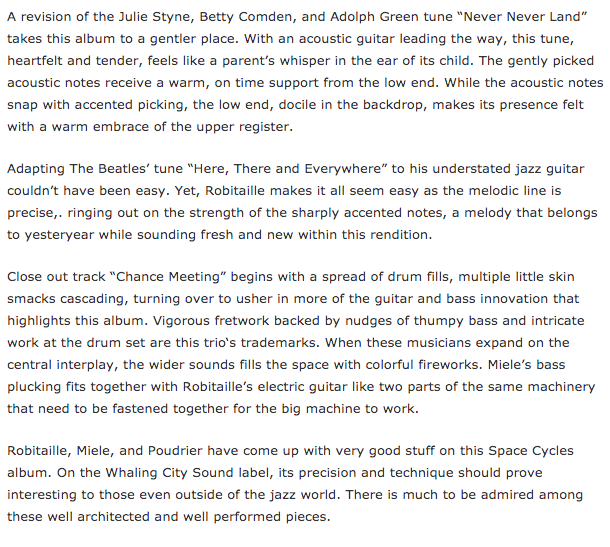


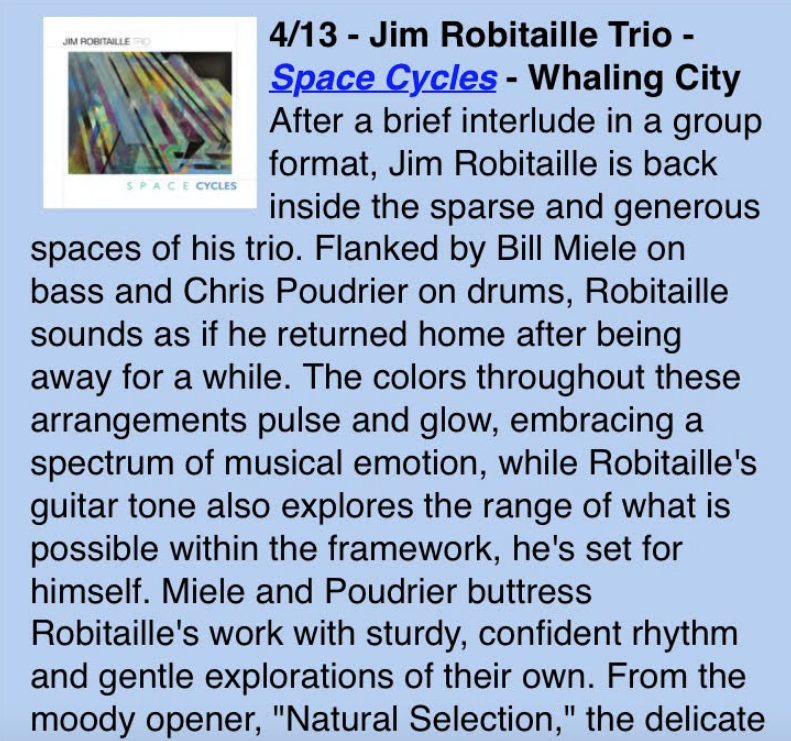

American jazz guitarist Jim Robitaille, who constantly collaborates with the label Whaling City Sound, and looks like and does not look like himself, if you compare his last year’s album A View From Within (a review of the disc is on the site) and the current Space Cycles. Similar, because his compositional imagination and soft, somehow cozy sound, which the authors of the press release for the new album compare with the tradition of Legato, coming from Jim Hall, Abercrombie and Schofield, have not gone away. And it doesn’t look like it, because Space Cycles is recorded in a completely different format – a classic trio with a guitar and a rhythm band. In fact, A View From Within also featured the same trio, but with a significant addition: then there was a saxophonist next to Robitaille on the stage, and not just anyone, but Dave Liebman himself. The main plot of that album was based on the interaction of guitar and saxophone. In Space Cycles, Jim Robitaille reigns supreme. Of course, it is tightly and qualitatively supported by the rhythm group (both musicians, bass guitarist Bill Miele and drummer Chris Poudrier, I have not heard before) – the king, as you know, makes a retinue, and in this sense, Jim’s partners are quite on the level.
Of the ten songs on the album, Robitaille wrote seven. Of the three covers of the program, I, as a person who grew up on Beatles music, was particularly pleased with the jazz version of the Lennon and McCartney song Here, There, and Everywhere. But even more interesting to listen to their own compositions Robitaille. Jim played the title song Space Cycles very temperamentally and with a good drive, but, as I think, at heart he is still more of a lyricist. Both the starting Natural Selection, and the elegiac When We Passed, and the strict Nocturne – here the beauty of the sound of the Robitaille instrument in the slow pace of music is revealed with special force. Jim in all the pieces, both his own and arranged, stylistically remains within the framework of post-BOP. Hand on heart, the modern mainstream is not always interesting to listen to. Unfortunately, many young musicians, having mastered jazz technique perfectly at Berklee and other modern schools, do not always know what they really want to say with it. Jim Robitaille well-versed in the categories of “what”, “how” and “why”. This is probably why listening to his music is both interesting and enjoyable.
Review by Leonid Auskern
Watch Jim’s new video for “Natural Selection”
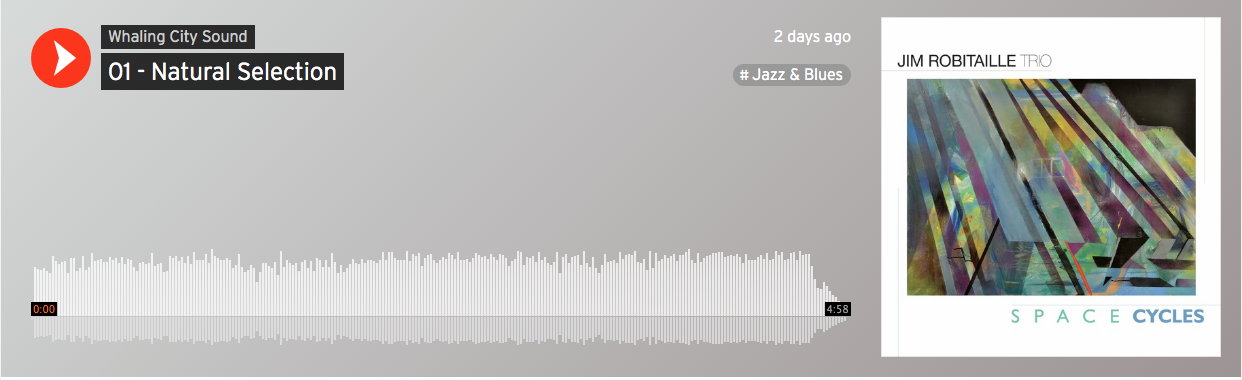
Click here to listen to “Natural Selection”
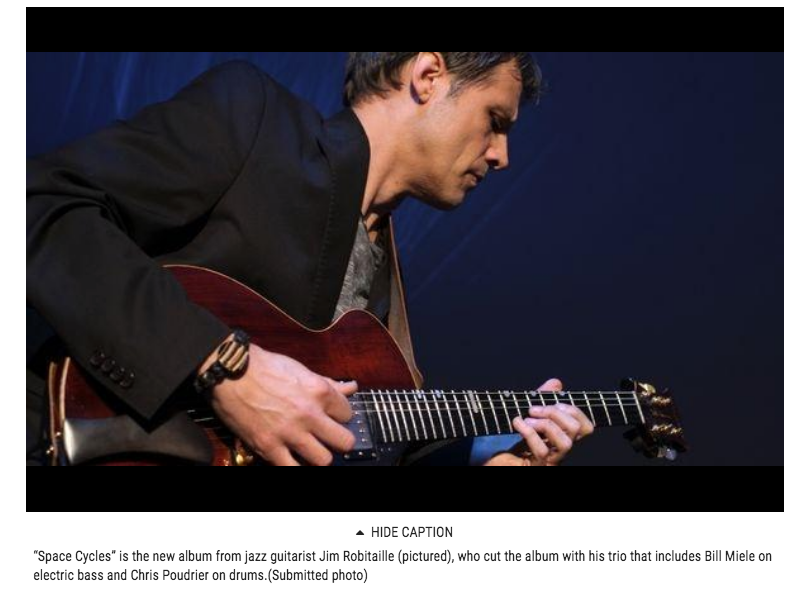
After a brief interlude in a group format, Jim Robitaille is back inside the sparse and generous spaces of his trio. Flanked by Bill Miele on electric bass and Chris Poudrier on drums, Robitaille sounds as if he’s returned home after being away for a while. Originally, the trio evolved out of a jam session series Robitaille ran out of UMass Dartmouth and today it has certainly become a part of his musical DNA.
Like most of his previous trio work, Space Cycles explores the lexicon of post-bop jazz, but also features a variety of roots and branches. The sonic spectrum spans delicate ballads and energetic funk. The recording features seven Robitaille originals along with three covers—the jazz standard “Baubles, Bangles and Beads,” “Never Never Land” (from the 1954 Broadway musical Peter Pan), and the Beatles’ “Here, There and Everywhere.” The canvas is vast and allows for the trio to paint in vibrant colors as it spreads out before them.
From the moody opener, “Natural Selection,” to the closing, epic ensemble jam “Chance Meeting,” the session is dazzling, even sublime. The colors throughout these arrangements pulse and glow, while Robitaille’s guitar tone—born in the legato tradition of names like Hall, Abercrombie and Scofield—articulates a palette of explosive creativity. At his side, Miele and Poudrier support Robitaille’s work with sturdy, confident rhythm and gentle explorations of their own. Miele shines frequently, in spots such as his melodic solos on “All the Things You Are” and “When We Passed.” Poudrier is loose on “Baubles, Bangles and Beads,” and he comes out swinging on “Chance Meeting,” helping the trio to close out the session with freewheeling brio. It is a fitting end to an album that feels like a journey, punctuated by exhilarating straightaways, gorgeous viewpoints, and chilled out rest areas.
Like a flowing, casual conversation among old friends, the comfort level of the musicians here feels brisk, amusing, impressive, and, above all, satisfying to hear. Robitaille is coming into a new level of expression. His musical scope has evolved, as has the tone from his guitar, leaping over traditional jazz into the great and jazzy unknown, a place where Robitaille, with the help of his longtime accompanists, clearly feels wonderfully familiar.

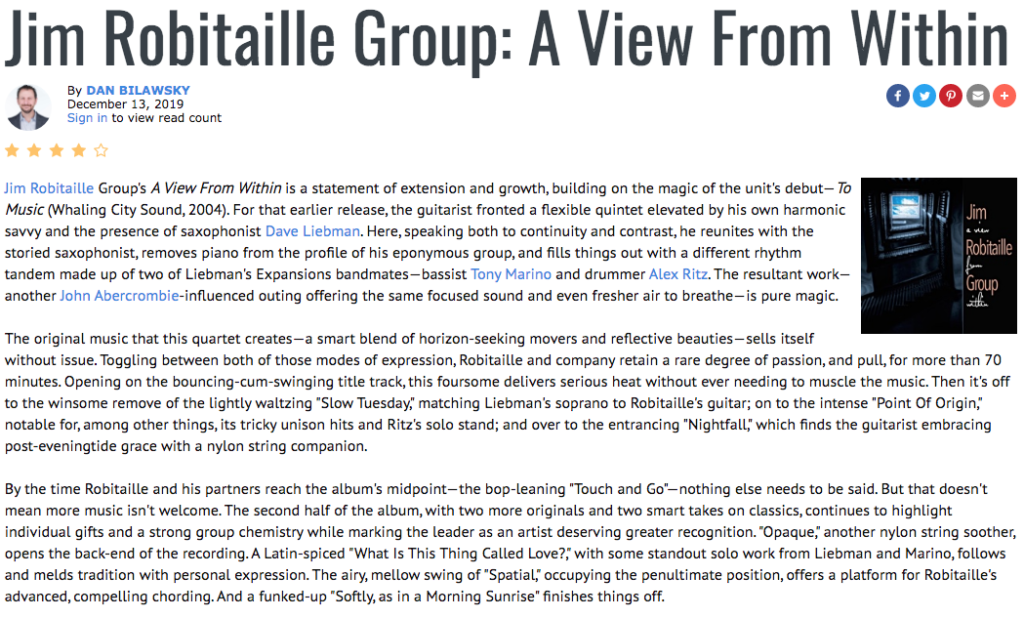
Positive reviews are coming in for “A View From Within,” an album of jazz released in October by The Jim Robitaille Group on the local label Whaling City Sound. A professor at UMass-Dartmouth, Robitaille is a guitarist teamed with three esteemed musicians, foremostly internationally renowned saxophonist Dave Liebman. “These compositions represent my goals of creating a personal style and sound in my playing and writing with my instrument,” Robitaille said. “I want to make a statement with a natural, authentic sound and expression in the music and the playing, and hopefully the emotional elements of the music moves people.” The online publication All About Jazz described the record as “pure magic, fire and finesse with a rare degree of passion. (Robitaille) is an artist deserving greater recognition.”



Click here to read the full review!
A View from Within
Jim Robitaille Group
Whaling City Sound
www.whalingcitysound.com
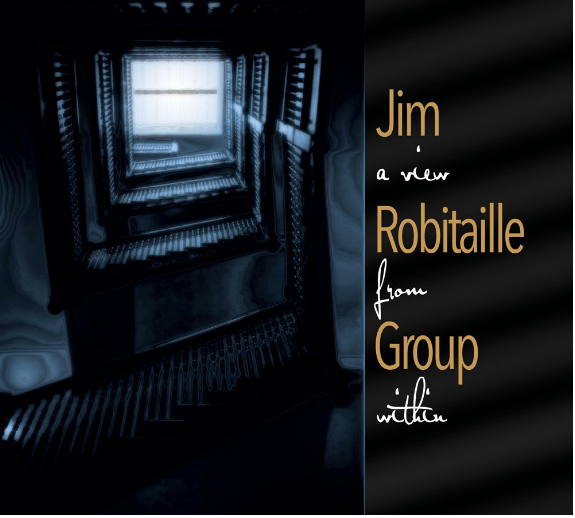
Award-winning guitarist Jim Robitaille and Dave Liebman (soprano and tenor saxophones), Tony Marino (double bass), and Alex Ritz (drums) present A View from Within, a vibrant jazz album that captivates the listener with its extraordinary flair. A treasure for connoisseurs of the genre, A View from Within is highly recommended for personal and public library jazz guitar collections, and also makes an excellent gift! The tracks are “A View from Within”, “Slow Tuesday”, “Point of Origin”, “Nightfall”, “Touch and Go”, “Opaque”, “What is this Thing Called Love”, “Spatial”, and “Softly, as in a Morning Sunrise”.
by James Cox of Midwest Book Review


Click here to pre-order from ArkivJazz

Listen to the first single “A View From Within” on SoundCloud!


 Music industry consultant and publicist Ginny Shea has garnered international exposure for her clients through radio and video promotion, print media, and her vast industry network.